
Your Subscribers Trust You… So What’s Stopping the Sale?
Part 4 of 5: Why Still No Sales From My Email List?
You’ve Done the Work… So Where Are the Sales?
In our previous article, “Where Do You Find Potential Buyers?” we explored how to attract people who are genuinely interested in the solutions you’re offering.
We talked about finding the right audience, understanding what they’re searching for, and giving them a reason to join your email list.
But now comes another question that can leave even the most enthusiastic beginner scratching their head.
“Why still no sales from my email list?”
Think about it.
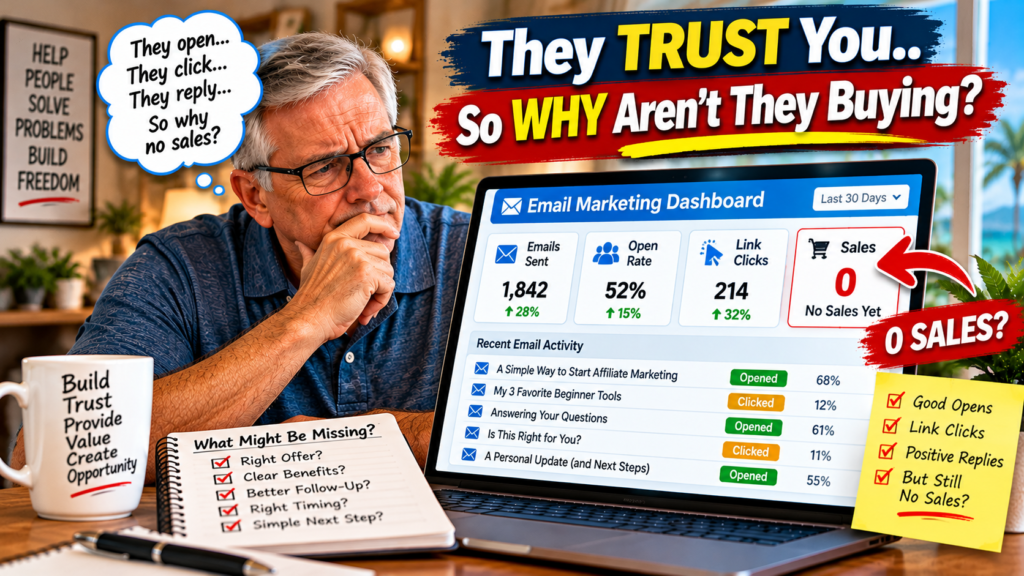
You’ve started building your list. You’re sending helpful emails. Some subscribers are opening your messages, clicking links, and perhaps even replying with questions.
You feel like you’re making progress.
But when you check your affiliate dashboard, there’s still that disappointing number staring back at you.
Zero sales.
Sound familiar?
I understand how frustrating that can be, especially when you’re retired or over 50 and trying to learn something completely new.
But here’s something worth remembering.
A lack of sales doesn’t automatically mean your email marketing isn’t working. It may mean something in the journey from subscriber to customer needs attention.
Let’s explore five possible reasons—and what we can do about them.
1. Trust Doesn’t Always Mean Someone Is Ready to Buy
Here’s something I’ve come to appreciate.
Just because someone trusts your advice doesn’t mean they’re ready to make a purchase.
Imagine you’ve been talking with a friend about buying a new computer.
Your friend appreciates your recommendations and trusts your judgment.
But perhaps they’re still comparing prices.
Maybe they’re waiting until next month.
Or maybe they’re simply not convinced they need a new computer yet.
Does that mean they don’t trust you?
Of course not.
The same thing happens with your email subscribers.
Someone may genuinely enjoy your emails and appreciate your beginner-friendly explanations without being ready to purchase affiliate marketing training.
That’s why it’s important to recognize the difference between interest and buying readiness.
Instead of constantly asking subscribers to buy something, continue helping them understand their options.
Explain who a product is designed for, what problem it addresses, and what someone should consider before purchasing.
Sometimes the most helpful thing you can do is give people the information they need to make their own decision.
Trust opens the door. Readiness determines when someone walks through it.
2. Are You Recommending the Right Solution to the Right Person?
Let’s say you have a subscriber who’s completely new to affiliate marketing.
They don’t understand what an email autoresponder does, haven’t built a website, and are still learning basic terminology.
Now imagine sending them a recommendation for an expensive, advanced marketing automation platform.
Even if it’s a great product, it probably isn’t the right solution for that person.
The problem isn’t necessarily the product.
It’s the match between the product and the subscriber’s needs.
This is one reason I’ve become increasingly interested in understanding my audience rather than simply growing my subscriber count.
For beginners over 50, simplicity and clear instructions may matter more than sophisticated features.
Before recommending something, ask yourself:
- What specific problem does this solve?
- Is it appropriate for someone at this experience level?
- Can I explain its benefits without complicated terminology?
- Would I feel comfortable recommending it to someone I know personally?
Those questions can help you make better recommendations.
The best affiliate offer isn’t necessarily the one paying the highest commission. It’s the one that genuinely fits your audience.
And when people recognize that you’re considering their needs, you’re building something much more valuable than a single sale.
You’re building credibility.
3. Are You Explaining the Benefits—or Just Listing Features?
Here’s a mistake that’s surprisingly easy to make.
You find a product with some impressive features and start describing everything it includes.
Automated follow-ups!
Landing page templates!
Tracking dashboards!
Advanced integrations!
Sounds exciting, doesn’t it?
Well, perhaps to someone who’s already experienced in online marketing.
But imagine a beginner reading that email.
They might be thinking:
“Okay, Stephen, but what does any of that actually do for me?”
That’s the question we need to answer.
People don’t usually purchase something simply because it has a long list of features.
They want to understand how those features might help solve a problem.
For example, instead of saying:
“This system includes an autoresponder.”
You might explain:
“An autoresponder allows you to send helpful follow-up emails automatically, so you don’t have to write and send every message individually.”
See the difference?
One describes a feature.
The other explains why that feature might be useful.
When you’re writing emails, try connecting each important feature to a real problem your audience understands.
Don’t exaggerate the benefits or promise results that aren’t guaranteed.
Just explain clearly what the product does, who it may help, and where its limitations are.
Clarity often does more to encourage a purchase than excitement alone.
4. Is Your Email Giving Subscribers a Clear Next Step?
Let’s imagine you’ve written a helpful email about building an affiliate marketing business.
You’ve explained the problem, shared a few tips, and introduced a useful training resource.
But then the email simply ends.
What should your subscriber do next?
Visit your website?
Read another article?
Explore the training program?
Reply with a question?
If you don’t make the next step clear, some subscribers may do nothing—even if they’re interested.
This is where a simple call to action becomes important.
And no, a call to action doesn’t have to sound pushy.
It could be something as straightforward as:
“If you’d like to explore the beginner training I’m using, you can learn more here.”
Or:
“Not sure whether this would be right for you? Reply to this email and let me know what you’re struggling with.”
The key is giving readers a logical next step that fits the information you’ve shared.
I prefer keeping that next step simple.
One email. One main message. One clear action.
That approach is especially helpful when your audience includes people who may already feel overwhelmed by technology.
Don’t make subscribers guess what to do next. Show them a simple path forward.
5. Are You Following Up—or Giving Up Too Soon?
This final point may be one of the most important.
Building an email list is not the same as building relationships with the people on that list.
Relationships develop through consistent communication.
Think about the businesses you’ve trusted over the years.
Chances are, you didn’t develop that trust after a single interaction.
You got to know the people involved.
You saw how they handled questions.
You learned whether they delivered what they promised.
And eventually, you felt comfortable doing business with them.
Email marketing works in a similar way.
One helpful email probably won’t answer every question a subscriber has.
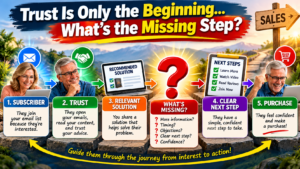
That’s why a thoughtful follow-up sequence can be valuable.
For example, you might send:
- A welcome email explaining what subscribers can expect.
- A helpful lesson addressing a common beginner problem.
- A personal story about something you’ve learned.
- A recommendation for a relevant resource, including who it’s suitable for.
- A follow-up answering common questions or concerns.
Notice that every email isn’t a sales pitch.
You’re providing information, developing trust, and helping people make informed decisions.
You also need to respect subscribers who aren’t interested. Make unsubscribing easy and honor their preferences.
Consistent, useful communication matters more than repeatedly asking people to purchase something.
Sometimes You Need a Simple System, Not Another Marketing Tool
After running an engineering service bureau with my wife for more than 30 years, I learned that a dependable process can make a tremendous difference.
You don’t solve every business problem by purchasing another piece of equipment.
Sometimes you improve the process you’re already using.
I believe affiliate marketing works much the same way.
If your email list isn’t generating sales, the answer may not be another expensive software subscription.
Perhaps you need a clearer message.
A more relevant offer.
A better follow-up sequence.
Or a simpler way for subscribers to learn about the products you’re recommending.
That’s one reason I’ve found value in being part of the Clickbank Profit Club.
It provides a place to explore affiliate marketing training, tools, and resources while developing a more organized approach to building an online business.
I’m still learning and refining my own system, and I appreciate having resources that help me work through the process.
But no training program can guarantee sales.
Ultimately, we still have to understand our audience, provide genuine value, and apply what we’re learning.
For me, that’s what building a real business is all about.
Before You Send Another Sales Email, Try This
If you’re wondering why there are still no sales from your email list, here’s a simple exercise.
Choose one product you’re currently promoting.
Then review the last few emails you’ve sent about it.
Ask yourself:
Does this email address a problem my subscribers actually have?
Have I explained why the solution might be helpful?
Have I given readers a clear, comfortable next step?
If the answer to any of those questions is no, you’ve identified something worth improving.
You don’t have to rebuild your entire funnel overnight.
Start by improving one email.
Then pay attention to what happens.
Are subscribers clicking through?
Are they asking questions?
Are they reaching the offer page but not purchasing?
Those details can help you understand whether the issue is your message, the offer, the sales page, or something else.
And remember, if your list is still small, it may take time to collect enough information to recognize meaningful patterns.
Final Thoughts: Don’t Confuse Slow Sales With Failure
If there’s one thing I’d like you to take away from today’s article, it’s this:
Getting subscribers to trust you is important, but helping them confidently choose the right solution is what moves the relationship forward.
Not everyone will purchase.
Not every recommendation will be a good fit.
And not every email will produce immediate results.
That’s simply part of learning how affiliate marketing works.
For those of us starting this journey later in life, patience and persistence are especially valuable.
Keep learning.
Keep improving.
And most importantly, keep putting your subscribers’ needs first.
Coming Up in Part 5: Should You Buy a Buyers List—or Build Your Own?
We’ve now explored why subscribers open emails without buying, how to attract better prospects, where to find potential buyers, and what may be preventing interested subscribers from making a purchase.
But there’s one more question worth discussing.
Wouldn’t it be easier to simply purchase an email list filled with people who have already bought something?
It sounds tempting, doesn’t it?
In our fifth and final article, we’ll explore whether buying a buyers list is really a shortcut worth taking—or whether building your own permission-based email list is the better long-term approach.
We’ll discuss the potential risks, the importance of subscriber permission, and what it means to build an audience you can continue serving.
I hope you’ll join me for the conclusion of this series!
Want a Simpler Way to Learn Affiliate Marketing?
If you’re over 50, retired, or just getting started with affiliate marketing, you’re welcome to explore the Clickbank Profit Club with me.
It’s one of the resources I’m using as I continue learning about email marketing, list building, and creating a more focused online business.
You can join my team as a FREE member, explore the available resources, and decide whether it’s a good fit for your goals.
Learn More and Join My Free Clickbank Profit Club Team
There’s no pressure to purchase anything. Just an opportunity to learn and take another step forward.
Thanks for spending a little time with me today.
Until next time, keep learning, keep moving forward, and remember—progress comes from improving the process, not chasing perfection.
— Stephen Wallace
StephenWallaceOnline.com — Helping Beginners Over 50 Find Clarity in Online Marketing
Affiliate Disclosure: Some links in this article are affiliate links, which means I may earn a small commission if you purchase a product or service through one of my links, at no additional cost to you. Thank you for supporting my website and allowing me to continue sharing helpful information and resources.